Most vegetables don’t go off in your fridge. They go off in the wrong part of your fridge, in a bag that’s trapping moisture, next to a fruit that’s actively gassing them.
How to store vegetables in the fridge, in one line: leafy things in the humid drawer, fruit in the dry one, a handful of things not in the fridge at all — and almost nothing in the plastic bag it came home in. Everything below is the detail behind that sentence, in the order it costs you money.
Which drawer does what?
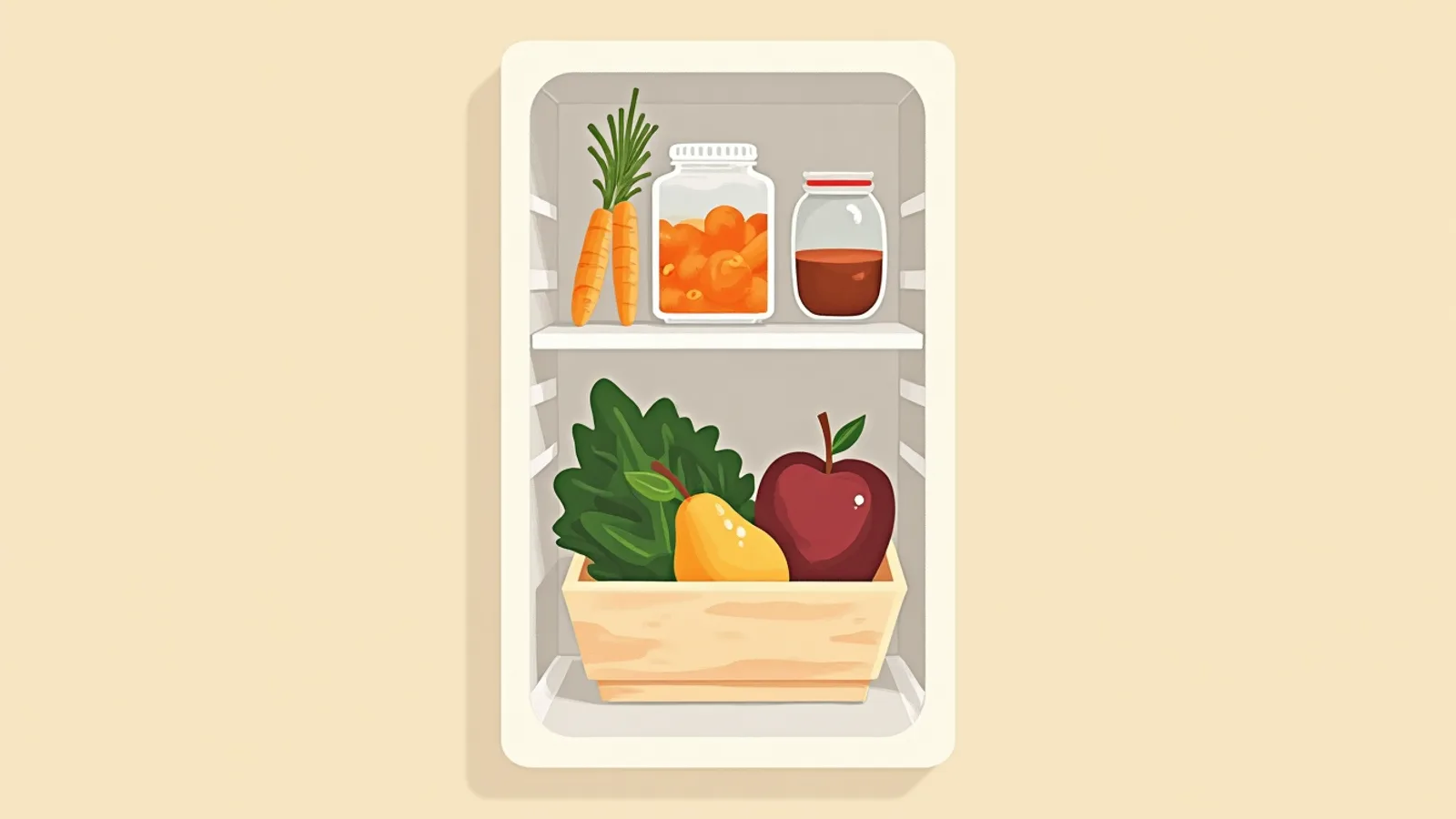
The two crisper drawers aren’t decoration and they aren’t the same. That little slider on the front changes how much air escapes, which changes the humidity inside, and the two settings are for two opposite problems.
High humidity — the closed setting. For anything that wilts: lettuce, spinach, kale, herbs, spring onions, cucumber, courgette, broccoli, green beans. These lose water to the air and go limp. Trapping moisture around them is the point.
Low humidity — the open setting. For anything that rots: apples, pears, avocados, stone fruit, and any vegetable stored alongside them. These give off ethylene gas as they ripen, and letting it vent stops the gas building up.
That’s the whole mechanism, and it explains the classic domestic mystery: why a perfectly good bag of spinach turns to sludge in three days when there are apples in the same drawer. The apples were ripening the spinach. Split them up and the spinach lasts a week.
Strong ethylene producers worth keeping apart from everything else: apples, bananas, avocados, tomatoes, peaches, plums, melon. The sensitive crowd: leafy greens, broccoli, carrots, cucumbers, green beans, asparagus.
Where does the fruit go, then?
In the low-humidity drawer, and most of it only once it’s ripe. How to store fruit in the fridge is really one question asked over and over — is this still ripening, or is it done? — because cold halts ripening without reversing it. Chill a peach too early and it stays that peach forever.
- Berries: fridge, unwashed, in something that isn’t sealed shut. Washing before storing is the fastest way to grow mould on raspberries; wash the handful you’re about to eat.
- Apples, grapes, cherries: fridge, dry drawer, and apples kept well away from anything leafy.
- Peaches, plums, nectarines, pears, avocados, mangoes: the counter until they give slightly under a thumb, then the fridge to hold them there.
- Bananas: the counter, on their own. Cold blackens the skin in a day, and they gas everything standing near them.
- Melon: whole on the counter, cut in the fridge and covered.
- Citrus: either. A week in a bowl, a month in the drawer.
Tomatoes are technically fruit, and they’re the reason the next section exists.
Which vegetables should never go in the fridge?
Five, and this is the shortest list to memorise for the biggest gain:
- Potatoes. Cold converts their starch to sugar. They go sweet, and they brown strangely when cooked. Cool, dark, ventilated — not the fridge.
- Onions and garlic. They want dry and airy. In the fridge they go soft and start sprouting.
- Tomatoes. Below about 12°C the texture goes mealy and the flavour flattens out, permanently. Counter until fully ripe; fridge only to buy a day or two after that.
- Basil. It’s tropical. Cold blackens it within a day. Stems in a glass of water on the counter, like flowers.
- Winter squash, whole. Weeks in a cool cupboard, days in a fridge.
One more that isn’t about temperature: don’t store potatoes and onions together. Onions give off moisture and gas that makes potatoes sprout faster. They’re the two things most likely to be in the same basket, and the pairing is why they both keep going off at once.
Why does everything go slimy?
Because it’s wet, and because it’s sealed in with its own condensation. Water on the outside of a vegetable is what bacteria need to get going, and a knotted supermarket bag is a small greenhouse.
So: don’t wash before storing. Wash right before you cook. And swap the bag it came in for something that breathes, or at least isn’t sealed — a container with a sheet of paper towel in it works, and the towel is doing real work, absorbing the moisture the leaves give off.
Mushrooms are the exception that proves the rule — they want a paper bag, never plastic, because they’re mostly water and will sweat themselves into slime in anything airtight.
What keeps for weeks in water?
The trick nobody’s parents taught them: several vegetables keep dramatically longer submerged or standing in water, changed every few days.
- Carrots, peeled or not, fully submerged in a tub of water: two to three weeks, still snapping.
- Celery, same treatment, and it stops going bendy.
- Asparagus, standing upright with the cut ends in an inch of water, loosely covered. Treat it like a bouquet.
- Herbs — parsley, coriander, dill — cut ends in a jar of water, a loose bag over the top, in the fridge. Basil gets the same jar but stays on the counter.
It looks like extra effort. It’s about ninety seconds when you unpack the shopping, and it’s the difference between using a bunch of coriander and throwing away three-quarters of one, which is the single most common small waste in a domestic kitchen.
Can you store vegetables without a fridge?
Yes — for the ones that never wanted one. A cool, dark, ventilated spot handles potatoes, onions, garlic, winter squash and whole pumpkins for weeks or months, and that’s most of the bulk of a vegetable shop by weight.
What you can’t do without refrigeration is keep leaves. Salad, spinach, herbs and anything already cut are on a clock measured in hours at room temperature. If fridge space is the constraint, buy those in small amounts often and give the space you have to them.
What about the freezer?
Freeze the ones you’ll cook, not the ones you’ll eat raw. Peas, beans, broccoli, cauliflower, carrots, spinach, peppers and sweetcorn all freeze well — but blanch them first: thirty seconds to two minutes in boiling water, then straight into iced water. That step switches off the enzymes that would otherwise keep degrading colour and flavour while the vegetable sits there frozen, and skipping it is why home-frozen vegetables sometimes come back grey.
Don’t bother freezing lettuce, cucumber or radishes. They’re mostly water, the ice crystals wreck the cell walls, and they thaw into slime. There’s no technique that fixes it — more on what does and doesn’t survive in how to actually use your freezer.
How long does any of this actually last?
Roughly, once stored properly and kept at 4°C or below:
- Leafy greens, herbs: 5–10 days, dry and in the humid drawer
- Broccoli, cauliflower, green beans: about a week
- Peppers, courgettes, cucumbers: 1–2 weeks
- Carrots, celery in water: 2–3 weeks
- Cabbage, whole: a month or more
- Berries: 3–7 days, unwashed
- Apples, citrus: 3 weeks to a couple of months
- Potatoes, onions, squash (out of the fridge): 1–3 months
Treat those as planning numbers rather than promises — they assume a fridge that’s actually cold, which is worth checking with a thermometer once, and produce that was fresh when you bought it. The date on the bag tells you about the packing plant, not about the vegetable; if that distinction is fuzzy, best before vs use by untangles it in five minutes.
What to do this week
- Set the two drawer sliders. Closed for the wilters, open for the rotters. One minute, permanent effect.
- Move the apples out of the greens drawer. This alone buys you days on every bag of salad you’ll ever own.
- Unbag everything. Swap sealed plastic for a container with a paper towel, or leave the bag open.
- Take the five out of the fridge. Potatoes, onions, garlic, tomatoes, basil.
- Put the carrots and celery in water. Then look at them in two weeks and be quietly annoyed about the years before this.
- Write down what’s now where. The system only holds if you can see it without opening the door — a note, a whiteboard, or the free inventory template, which has a Where column for exactly this.
None of it is about discipline. It’s about putting things where they were always going to survive, once, and then not having to think about it again.
Step six is the one that decays, which is why we’re building shElf — the Where column, kept current from a photo instead of a pen, with the expiry dates estimated for you. The other five steps are free and permanent, and they’re most of the win.