During a move last year we emptied the kitchen cupboards into boxes and made a discovery: four open bags of flour. Four. Each one bought in good faith by a person who was certain there was no flour in the house, because the flour was thirty centimeters behind the point where light stops reaching.
That’s the pantry’s core deception. It doesn’t lose food — it hides food, and then lets you pay for the same items again. The fix isn’t a bigger kitchen or a container haul. It’s three boring rules and one good shelf.
The deep-shelf tax
Storage advice loves to celebrate depth — look how much it holds! But for food, depth is where visibility goes to die. Anything behind the front row effectively stops existing: you can’t cook what you can’t see, and you can’t not buy what you can’t see either. That’s the tax — paid in duplicate flour.
Two cheap countermeasures:
- The one-row rule. Nothing lives behind anything of a different kind. Duplicates can queue behind their own kind (backup pasta behind pasta) — that’s a supply line, not a hiding spot.
- Turn depth into drawers. A few open bins or even sturdy box lids, pulled out like drawers, convert “the dark zone” into “the thing I slide forward.” An entire shelf becomes visible in two seconds.
Decanting is mostly for the camera
The internet’s answer to pantry chaos is forty matching jars with minimalist labels. Let’s be honest about what that is: photography.
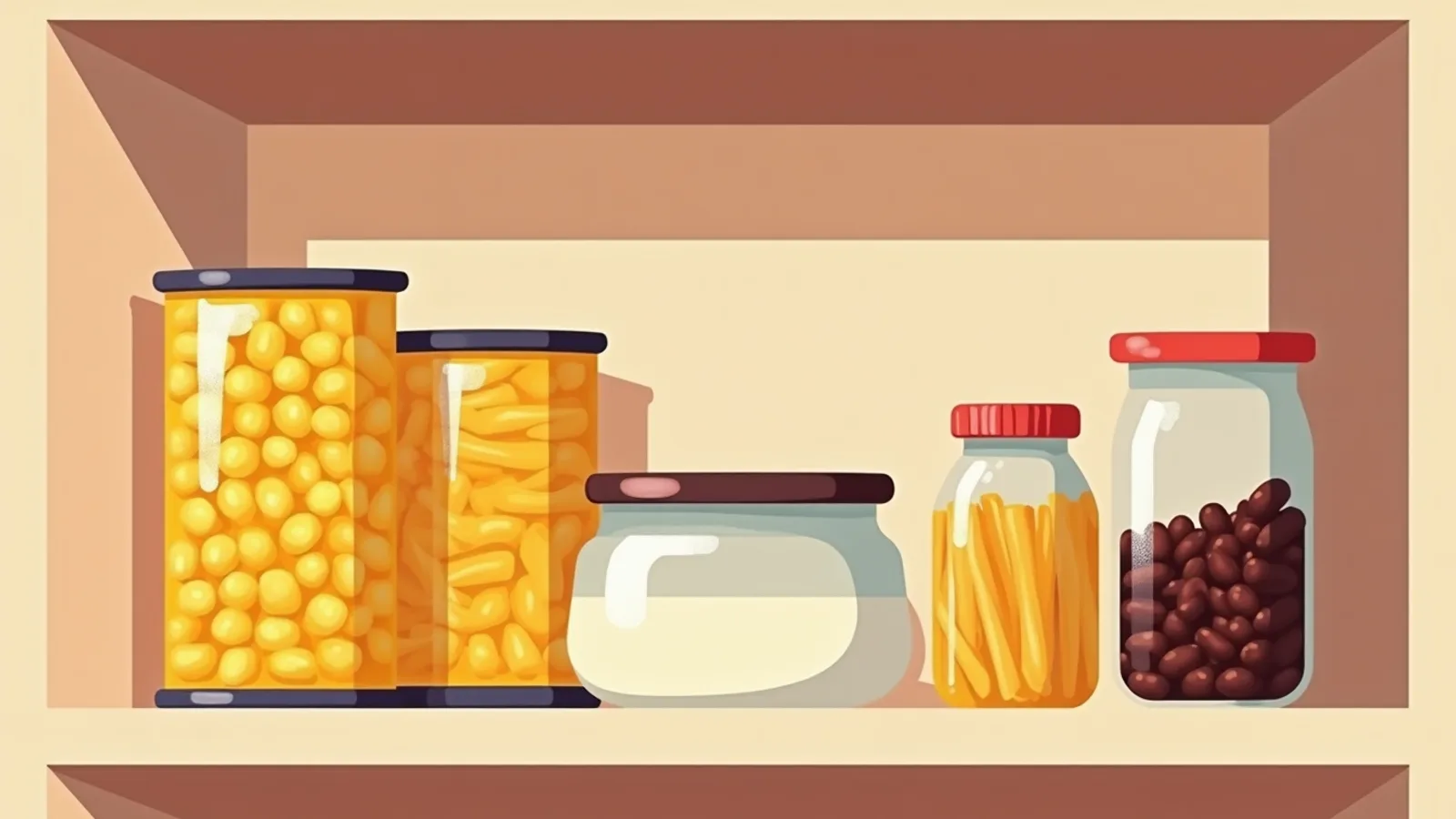
Decanting genuinely helps for a small set of high-turnover staples — rice, oats, flour, sugar, pasta — where a clear jar shows the level at a glance and refuses to be shoved into the dark. For everything else, the jar adds a chore (transfer, wash, label), deletes the cooking instructions and the date, and looks exactly as full whether the contents are three months or three years old.
If you do decant anything, write the date on the jar. Which brings up the pantry’s other lie — that dry goods are immortal:
- Ground spices don’t rot; they just quietly stop being spices. After a year or so they’re colored dust. Smell one — if it smells like a shelf, it seasons like a shelf.
- Whole-grain flours and nuts carry oils that go rancid at room temperature. If you bake rarely, the freezer holds them for months without complaint.
- Oils hate light and heat, which is a shame, because the prettiest place to keep them is next to the stove in a sunbeam.
The real system underneath all of this is dull and unbeatable: first in, first out. New groceries go behind the survivors, not in front of them. It’s one wrist motion at unpacking time, and it’s the entire difference between rotation and archaeology.
Keep a flavor shelf
Here’s the one genuinely fun pantry upgrade. Reserve a single small shelf — eye level, prime spot — for the things that make other things taste like dinner: anchovies, capers, olives, chili crisp, stock cubes, a head of garlic, soy sauce, tomato paste, the parmesan heel, a lemon or two.
None of these is a meal. All of them are the difference between “rice and a fried egg” and dinner. When you’re cooking backwards from whatever’s around, this shelf is the toolbox you reach for on every single pass — it deserves better real estate than the fancy vinegar you use twice a year.
Audit at the speed of shopping
The pantry doesn’t need the weekly attention the fridge gets — nothing in there dies overnight. It needs five minutes before the grocery list, once a week, with one question: what do we actually already have?
Front rows scanned, levels checked, the list gets shorter, and the flour census stays at one.
That’s the whole system. One row, honest jars or none, first in first out, one shelf of flavor. The pantry can stop lying any time you make it easier to see than to guess.
Easier to see is more or less the design brief for shElf, the app we’re building: a shelf you can read without opening the cupboard. The rules above don’t need it — they run on a marker pen and one honest afternoon.