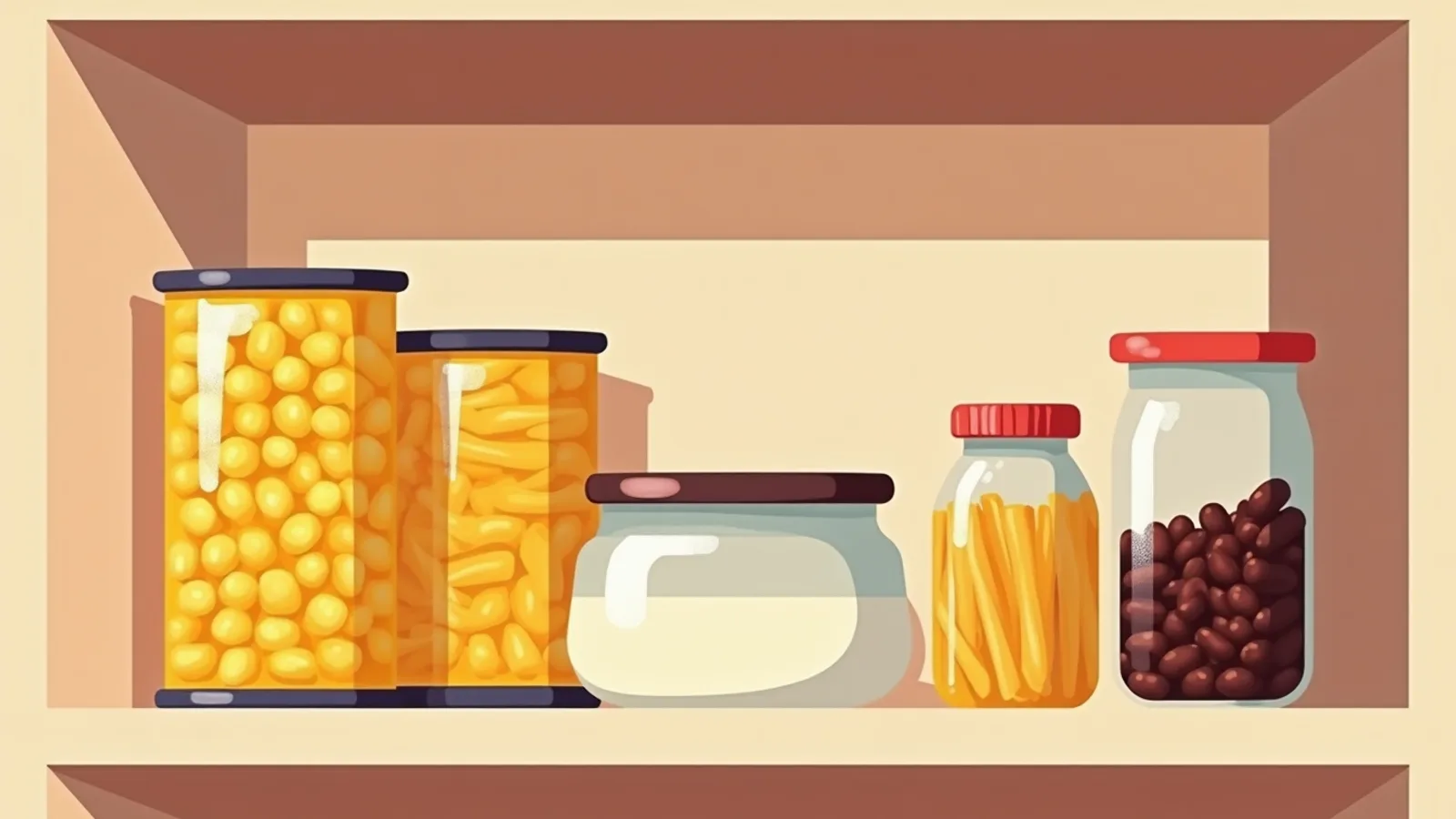
There are two tins of sweetcorn at the back of my cupboard and a tin of black beans behind them. I bought them for a Mexican dinner. That dinner has not happened. It has not happened for a while now.
This is the story the whole product came out of, so it’s worth telling properly.
Shopping is the fun part. That’s the problem.
I like cooking, I like eating well, and I genuinely enjoy grocery shopping — it’s close to therapy. Walking down an aisle looking at what’s there and thinking about what could be done with it is a good half hour of my week.
And every so often, standing in that aisle, I get inspired. Mexican, say. Or Japanese. Except what I actually have in my head is not a recipe — it’s a set of images. A vague, amateur sense of what belongs to that cuisine. So I buy the things that feel central to it. Tinned corn. Black beans. Something in a jar with a chilli on the label.
Then I come home, and those tins go on the shelf. Near the back, because the front is where the things I actually use live. And they begin collecting dust.
What happens instead
Dinner still needs to exist. So I open the fridge, and I make chicken pasta in cream, because I can make it without thinking and it is reliably good.
When the chicken and the cream run out, here’s the part I find genuinely interesting about my own behaviour: I don’t go and dig through the kitchen to see what could be combined into something. That’s work. It requires holding the whole inventory in my head and inventing against it, while hungry. So instead I pick up my phone and order chicken and cream again, because it’s simple and familiar and I know exactly what happens next.
The tins stay where they are.
Both endings are bad, and the second one is worse than it looks, because it costs an evening and produces a meal nobody enjoyed. That is not a food waste problem in the environmental sense. It’s a this is not how I want to eat problem, and the waste is a symptom.
What I actually wanted
Not a recipe app. I have thousands of recipes available to me and it has never once helped, because the constraint was never a shortage of recipes.
What I wanted was to have my own kitchen in my hand:
- I don’t want to stand in a shop not knowing what I need.
- I don’t want the low-grade guilt of food I bought with good intentions and never cooked.
- I don’t want to eat chicken pasta forever, punctuated by Chinese takeaway.
- And I really don’t want to be scrolling with floury hands mid-recipe, asking a chatbot whether I have an ingredient and how many grams of it — because it doesn’t know what’s in my kitchen, so I have to describe my kitchen to it, while cooking.
I wanted to work with my kitchen efficiently. That’s the whole ask.
The thing I keep thinking about
Sometimes I wonder how much people would get done if they didn’t have to eat. Add it up honestly — planning, deciding, the shop itself, unpacking, prep, cooking, the washing up — and food is one of the largest recurring blocks in a life.
But that framing is also wrong, and I know it’s wrong, because everybody likes eating. Good food is one of the more dependable sources of a good mood there is. A new recipe that works is a small version of visiting somewhere you’ve never been.
So the goal was never to make food take less time. It was to remove the part that’s pure overhead — the standing-in-the-aisle-not-knowing, the forgetting, the tins at the back — and leave the part that’s actually good.
Who this ends up being for
I built it for my problem, but the interesting thing is how differently people describe the same product back to us:
- Some come for fitness or a specific diet, and want the kitchen to stop fighting the plan.
- Some come for household efficiency and money — the same one-third of a shop being thrown away every month is real money.
- Some come for food waste specifically, out of conviction rather than economy.
- Some want to get better at cooking, and need the constraint of what’s actually here to do it.
- Some want to stop negotiating the kitchen with a partner or flatmates by text message.
- And some just like eating well and want more good days of it.
That’s five or six different reasons to open the same app, and I don’t think any of them is the real one. Food is the thing every single person has to come to terms with in their own way, and there’s room in that for a tool that makes it a bit simpler and a bit more pleasant.
What it costs, honestly
The catch, and I’d rather write it down than let you discover it: shElf is most valuable when what it thinks is in your kitchen is what’s actually in your kitchen. That’s a real cost, and no amount of design makes it zero.
So most of our effort has gone into making the updating cheap rather than pretending it isn’t there. A whole shop goes in as one photo, or one receipt. Voice handles the small corrections, because that’s the thing you can do with your hands in a pan — and it’s the tool I use most myself, which is why it keeps getting sharper. And when a shelf has drifted out of date, there’s a way back that isn’t an evening of typing.
Whether we’ve made that cheap enough is not something I get to decide. We watch how the product is actually used and keep making it simpler, and I’d rather hear the annoying version of your experience than the polite one — tell us what irritates you most about tracking apps, including this one.
The tins are still there, incidentally. I know exactly what they are and roughly when they expire, and one of these weeks something will get made with them on purpose rather than in a panic. That’s a smaller ambition than “reduce global food waste,” and it’s the one I actually care about.
If you want the non-app version of any of this, it’s all written down: cook backwards from your fridge is the method, your pantry is lying to you is why the back of the shelf eats your money, and the five leaks is the whole map. None of it requires installing anything.